If you run cranes in South Dakota, federal OSHA is the whole rulebook for operator certification and equipment inspection. The state adds no license, no crane certificate and no experience-hours threshold. What it does add is a power-line safety law, on the books since 1973, that reaches the operator as an individual and sets signage and clearance rules your federal compliance program may never mention.
That gap matters most when you are onboarding operators, bringing equipment in from another state, or setting up near overhead lines. Paradise Crane is based in Albuquerque and travels on-site across South Dakota, building training around the equipment your crews actually run and the lines they actually work near.
The mistake contractors make in South Dakota is trusting the sign. State law requires every crane, derrick and similar swinging-boom machine to carry a durable warning sign, legible at 12 feet and in plain view of the operator, that reads: "Unlawful to operate this equipment within six feet of high voltage lines." Six feet is not your working clearance, and the reason is a gap the legislature left behind.
South Dakota's overhead line law originally set six feet across the board. In 2002 the legislature raised the activity clearance to ten feet — 2002 Session Laws chapter 215 amended SDCL 49-32-11 from six feet to ten — but amended neither the equipment-proximity section nor the sign requirement. The sign still says six. The rule says ten. And the federal crane standard sets a 10-foot minimum for lines up to 50 kV, with planning required whenever equipment could get within 20 feet, so on higher-voltage lines even ten is not enough.
Enforcement for private-sector construction runs through federal OSHA's Sioux Falls Area Office. South Dakota has no OSHA-approved State Plan and issues no crane operator license, so 29 CFR 1926 Subpart CC governs operator certification and equipment inspection as written.
What South Dakota adds sits outside OSHA entirely: SDCL 49-32-10 to 49-32-17, which treats any line over 750 volts as high voltage. It applies to any "person," not only employers, so an operator can personally commit a Class 2 misdemeanor. A missing sign is a separate violation each day. Work inside the clearances requires notifying the line operator and arranging barriers, de-energizing and grounding, or raising the conductors first. And if a violation results in contact with the line, the violator is liable to the utility for all resulting damage.

NCCER certification is the right foundation for operating in South Dakota, and because the state issues no crane operator license, federal rules decide what else you need. Under 29 CFR 1926.1427, each operator must hold a certification valid for five years, and the employer must separately evaluate the operator on the equipment being run. That evaluation must be documented with the operator's name, the evaluator's name and signature, the date, and the make, model and configuration of the equipment, and the document must be available at the worksite. The employer provides certification at no cost to the employee.
South Dakota then adds power-line duties that no certificate satisfies on its own: the posted warning sign, the 10-foot activity clearance in SDCL 49-32-11, the 6-foot limit on operating or storing equipment near a conductor in SDCL 49-32-12, and the duty to notify the line operator before working closer. Federal rules also bar an uncertified operator-in-training from running equipment that could get within 20 feet of a power line up to 350 kV. Training that covers federal Table A clearances but never mentions the state statute leaves your operators personally exposed.
South Dakota recorded 29 fatal work injuries in 2024, up 45.0 percent from 20 in 2023, according to the U.S. Bureau of Labor Statistics Census of Fatal Occupational Injuries. The state's fatal injury rate rose to 5.8 per 100,000 full-time-equivalent workers, from 4.3 the year before, while the national count fell 4.0 percent to 5,070.
BLS reports construction had more fatalities than any other sector: 9 of the 29 deaths, or 31 percent, up from 4 in 2023. Specialty trade contractors accounted for 5 of those 9.
These are statewide figures covering all industries, not crane-specific data. They describe the conditions your crews work in, and they are the numbers a compliance officer has in mind on arrival at your site.
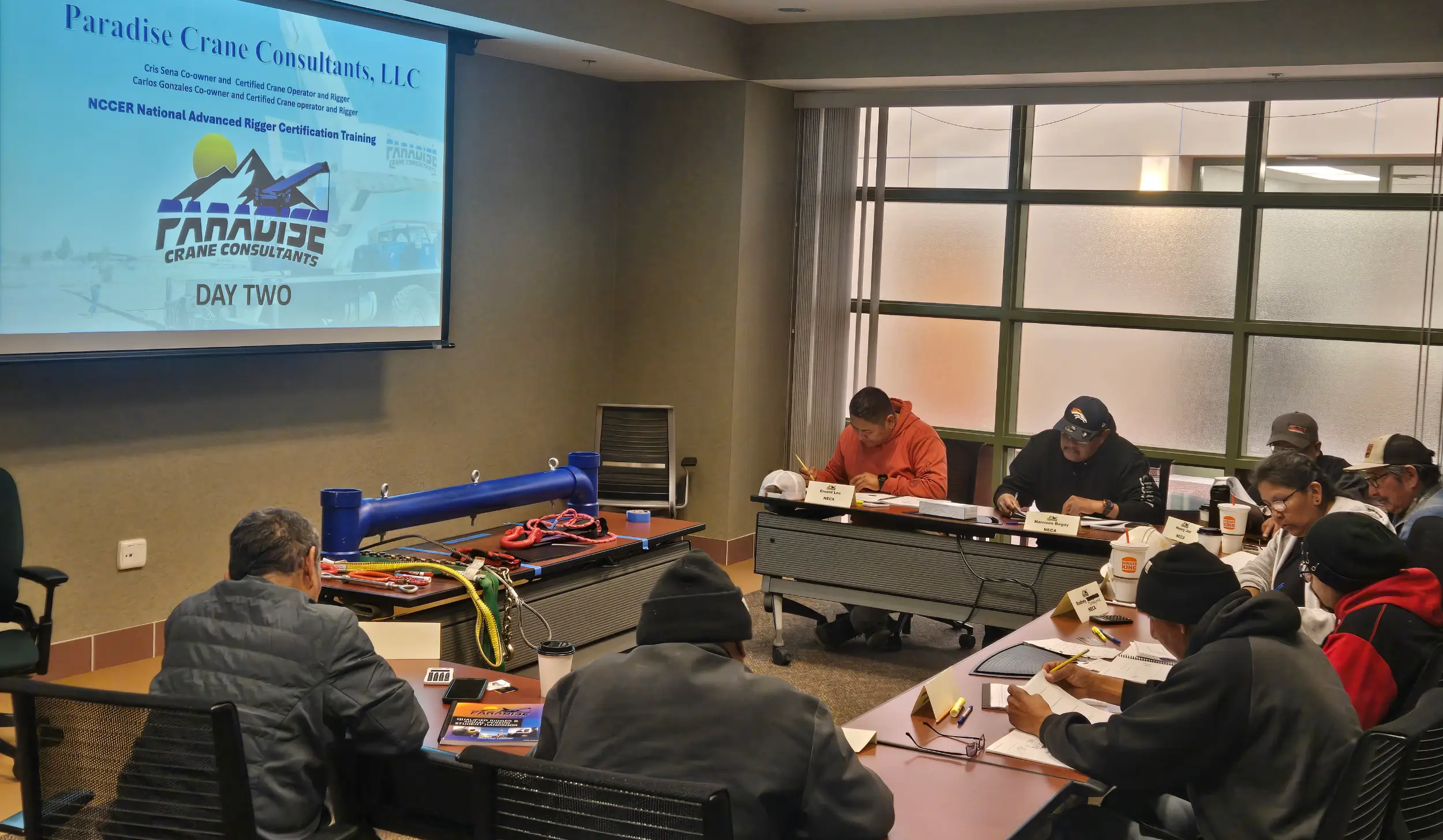
Paradise Crane delivers certification preparation and safety training tailored to your equipment type, crew size, and project needs.
Prepare your crew for nationally recognized certification exams with classroom and hands-on instruction.
Develop rigging skills and communication protocols essential for safe lift operations on your jobsite.
Train supervisors and coordinators to manage complex lift operations and equipment setup safely.
Meet OSHA requirements with qualified person training in fall protection systems and hazard recognition.
Ensure your team understands hazards and entry procedures for confined spaces and excavation work.
Train crane inspectors to identify defects and verify safe operating conditions for overhead crane equipment and related systems.
Paradise Crane has trained crane and heavy equipment operators since 1996, including work with the U.S. Department of Energy, Sandia National Laboratories, and Los Alamos National Laboratory.
Select a city below to learn more about on-site crane training and certification availability in your area.
Before your next covered lift in South Dakota, work through these in order:
Common questions about crane training and certification in Washington.
Yes. Paradise Crane delivers on-site training across Washington State. We coordinate scheduling and logistics to fit your crew's location and availability.
That's our standard approach. We bring classroom and hands-on instruction to your jobsite, yard, or facility to minimize downtime and travel.
Washington enforces its own crane rules through L&I (WAC 296-155 Part L), which exceed federal OSHA. Operators must hold a valid certificate from a nationally accredited testing organization for each crane type, and cranes must be certified and proof-load tested annually by an L&I-recognized certifier. Updated rules took effect September 5, 2025.
Paradise Crane recommends scheduling four to six weeks in advance. This allows time to coordinate travel, prepare materials, and align with your crew’s availability. Paradise Crane can in some cases accommodate classes booked as late as 7 days in advance, as long as our teaching schedule allows.
We provide certification preparation for NCCER and support training for crane operators, riggers, signalpersons, and lift directors. Paradise Crane also offers OSHA qualification classes and specialized safety training, including fall protection and confined space training.
Individual operators can enroll in open classes in Albuquerque; employers can book on-site NCCER crane training at any job site or yard in South Dakota.