If you run cranes in Oregon, the federal standard gets you most of the way, but not up the boom. Oregon adopts the federal crane rules almost entirely and then replaces the one section that governs your crew's fall protection on the equipment itself — with trigger heights that differ from the federal ones in both directions. A crew trained to federal numbers in another state can arrive non-compliant on its first assembly.
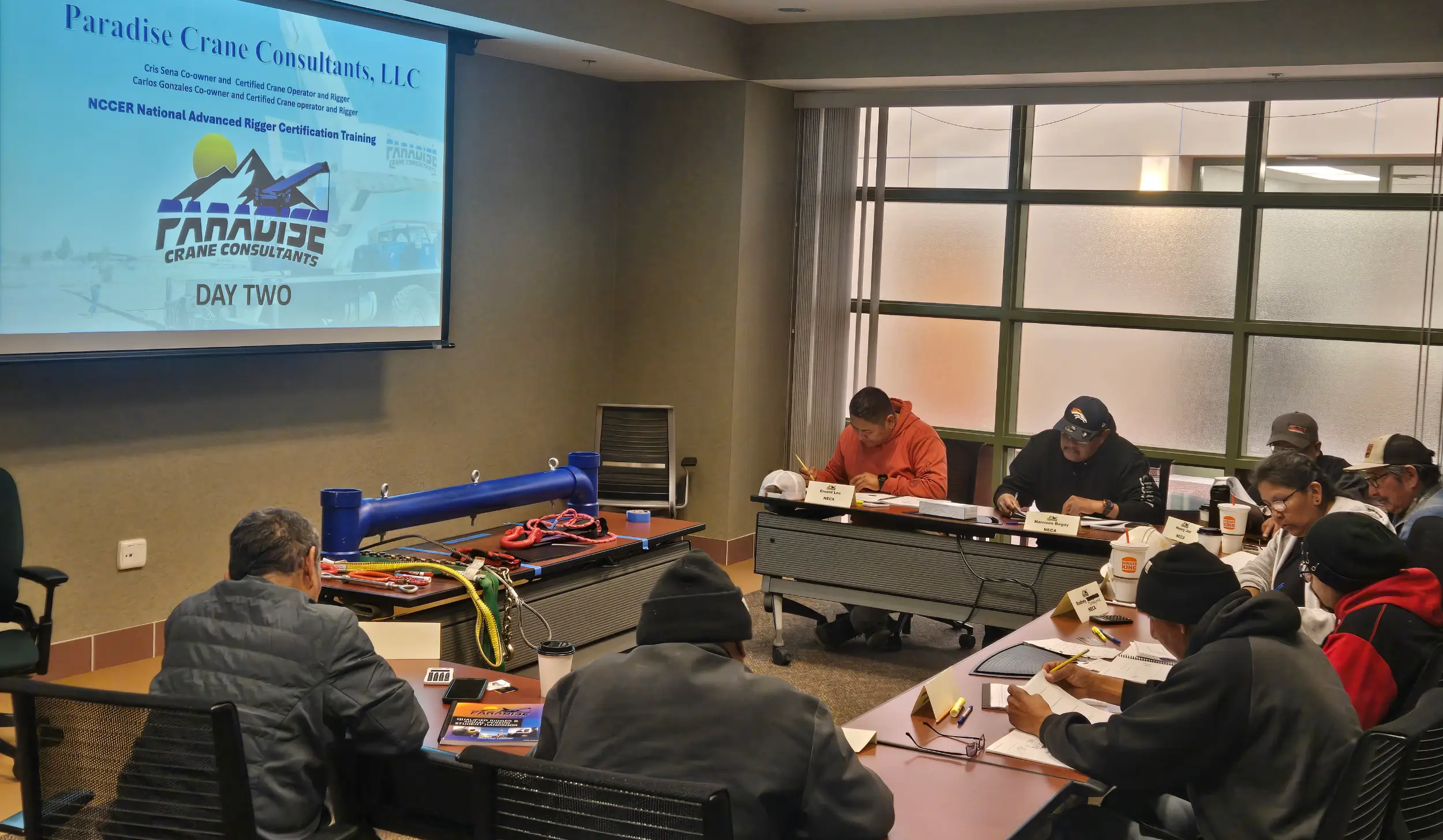
Individual operators can prepare for NCCER certification in open-enrollment classes in Albuquerque. For crews, Paradise Crane travels to your Oregon facility or job site and trains on the equipment you actually run, including the two fall protection triggers Oregon expects your people to know.
Oregon adopts the federal crane standard almost in full, then replaces the one section that governs your crew rather than your equipment. Workplace safety here is enforced by the Oregon Occupational Safety and Health Division — Oregon OSHA — within the Department of Consumer and Business Services, under a State Plan approved on December 28, 1972 that covers private employers alongside state and local government. 29 CFR 1926 Subpart CC is adopted by reference at OAR 437-003-0001(28), with one exception: Oregon wrote its own fall protection rule for cranes, OAR 437-003-1423.
That rule requires fall protection when anyone working on a crane's walking or working surface is exposed to an unprotected side or edge more than 10 feet above a lower level, and it applies the same trigger to erecting, climbing and dismantling tower cranes. Federal OSHA sets both of those at 15 feet. An assembly crew working to the federal number on an Oregon job site is unprotected across the five feet where Oregon requires protection, and that is the single most likely way to be cited here.
The rule's 10-foot figure cuts the other way for routine work, and the reason is historical. OAR 437-003-1423 was filed in 2011, when 10 feet was Oregon's general construction trigger. In 2016 Oregon OSHA lowered that general trigger to 6 feet, effective January 1, 2017 and made at federal OSHA's request, repealing the federal duty-to-have provision and substituting OAR 437-003-1501(1). The crane section was never conformed to that change. Federal OSHA requires 6 feet for non-assembly work on equipment, a State Plan cannot be less protective than the federal standard, and Oregon OSHA's own crane guide states 6 feet. So plan routine work on the crane to 6 feet and assembly, disassembly and tower crane work to 10.

NCCER certification is the right foundation for operating in Oregon, and it carries more weight here than in a state with its own licensing, because Oregon has none to fall back on. Oregon OSHA does not issue operator licenses for equipment covered by Subdivision CC. Employers rely on certification from a nationally accredited testing organization such as NCCER, or on an audited employer program.
Accredited certification is portable and valid for five years, and under 29 CFR 1926.1427(c)(3) the employer must provide it at no cost to the employee. It does not finish the job. Before an operator runs a crane unsupervised the employer must evaluate them on the assigned equipment and document it — the operator's name, the evaluator's name and signature, the date, and the make, model and configuration — and that record must be available at the worksite and kept for as long as the operator is employed. An operator moving to a crane type that requires additional certification returns to operator-in-training status until a new certification and evaluation are complete.
What Oregon adds sits beside certification rather than on top of it. Under OAR 437-003-1423(6), every employee who may be exposed to fall hazards while on, or hoisted by, covered equipment must be trained on Oregon's own construction fall protection rules, including the criteria at OAR 437-003-0502. Federal Subpart M training delivered in another state does not satisfy this, and your operators and signal persons need both Oregon trigger heights in hand: 6 feet for routine work on the equipment, 10 for assembly, disassembly and tower crane work.
Oregon recorded 52 fatal work injuries in 2024, down from 54 the year before, according to the U.S. Bureau of Labor Statistics Census of Fatal Occupational Injuries. The state's fatal injury rate was 2.6 per 100,000 full-time-equivalent workers, down from 2.8 in 2023.
Private-industry construction accounted for 8 of those deaths, 15 percent of the state total, up from 6 in 2023. Those eight split evenly: four in heavy and civil engineering construction and four among specialty trade contractors.
Two event categories are worth reading together on a crane site. Across all Oregon industries, being struck by a propelled, falling or suspended object caused 8 deaths, and falls to a lower level caused 7. Those are the two hazards a crane concentrates in one place — a suspended load and people working at height — which is why Oregon wrote its own rule about the second one.
These are statewide figures covering all industries, not crane-specific data.
Paradise Crane delivers certification preparation and safety training tailored to your equipment type, crew size, and project needs.
Prepare your crew for nationally recognized certification exams with classroom and hands-on instruction.
Develop rigging skills and communication protocols essential for safe lift operations on your jobsite.
Train supervisors and coordinators to manage complex lift operations and equipment setup safely.
Meet OSHA requirements with qualified person training in fall protection systems and hazard recognition.
Ensure your team understands hazards and entry procedures for confined spaces and excavation work.
Train crane inspectors to identify defects and verify safe operating conditions for overhead crane equipment and related systems.
Paradise Crane has trained crane and heavy equipment operators since 1996, including work with the U.S. Department of Energy, Sandia National Laboratories, and Los Alamos National Laboratory.
Select a city below to learn more about on-site crane training and certification availability in your area.
Before your next covered lift in Oregon, work through these in order:
Common questions about crane training and certification in Washington.
Yes. Paradise Crane delivers on-site training across Washington State. We coordinate scheduling and logistics to fit your crew's location and availability.
That's our standard approach. We bring classroom and hands-on instruction to your jobsite, yard, or facility to minimize downtime and travel.
Washington enforces its own crane rules through L&I (WAC 296-155 Part L), which exceed federal OSHA. Operators must hold a valid certificate from a nationally accredited testing organization for each crane type, and cranes must be certified and proof-load tested annually by an L&I-recognized certifier. Updated rules took effect September 5, 2025.
Paradise Crane recommends scheduling four to six weeks in advance. This allows time to coordinate travel, prepare materials, and align with your crew’s availability. Paradise Crane can in some cases accommodate classes booked as late as 7 days in advance, as long as our teaching schedule allows.
We provide certification preparation for NCCER and support training for crane operators, riggers, signalpersons, and lift directors. Paradise Crane also offers OSHA qualification classes and specialized safety training, including fall protection and confined space training.
Request on-site crane certification preparation and operator training tailored to your crew, equipment, and location anywhere in Oregon.