
New Mexico leaves the federal crane standard intact and adds a second requirement on top of it: a state crane-operator license for operators doing construction, demolition, or excavation work, unless an exemption under the Crane Operators Safety Act applies. Federal certification alone does not put an operator in compliance here.
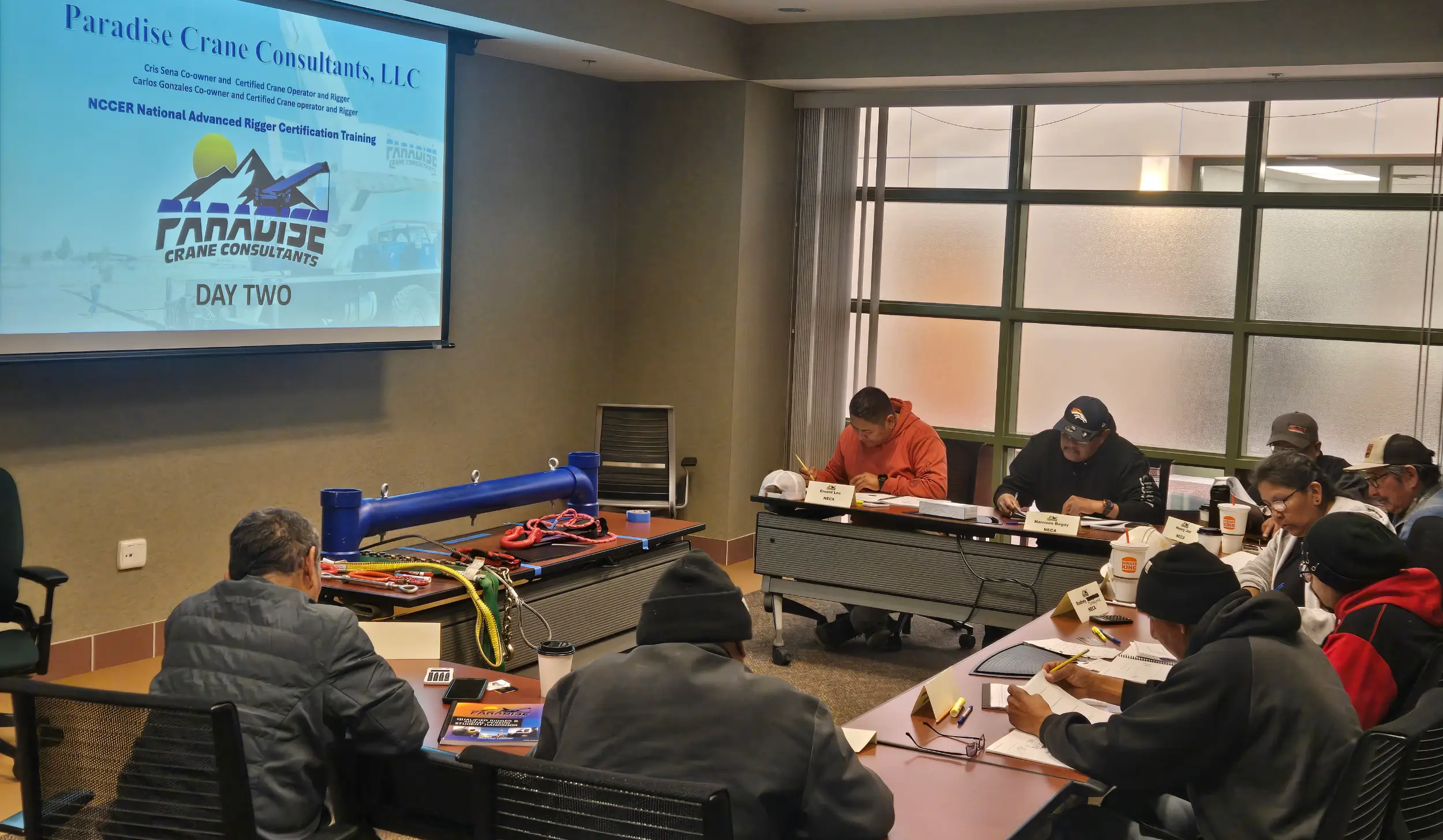
Individual operators can prepare for NCCER certification in open-enrollment classes in Albuquerque. For crews, Paradise Crane travels to your New Mexico facility or job site and trains on the equipment you actually run.
New Mexico does not rewrite the federal crane rules. It adds a license. Workplace safety is enforced by the New Mexico Environment Department's Occupational Health and Safety Bureau (NM OSHA/OHSB) under an OSHA-approved State Plan that covers most private-sector workers and all state and local government workers. The state construction rule, 11.5.3.9 NMAC, incorporates 29 CFR Part 1926, including Subpart CC, by reference. Its listed exceptions omit Subparts A and B and amend the hazard-communication provision. They do not list a crane-specific amendment to Subpart CC or to 29 CFR 1926.1427.
The difference is the state license. Under the Crane Operators Safety Act, NMSA 1978, §§ 60-15-1 to 60-15-15, crane operators performing construction, demolition, or excavation work need a current New Mexico crane-operator license unless an exemption under the Act applies. The New Mexico Regulation and Licensing Department (NMRLD) administers it through its Crane Operators Safety Program.

New Mexico licensing sits on top of federal certification. NMRLD states that applicants must provide documentation of an approved in-house training course and a nationally approved certification, pass an approved written general examination with a score of 75% or greater, and pass an approved Law & Safety Examination on the state program Act. The license also carries crane-type-specific experience and practical testing. For Class I and Class II, NMRLD describes experience as at least three years within the prior three years and at least 500 hours of seat time on the applicable crane type. Class III has no experience requirement and is described as supervised work.
NCCER national accreditation does not replace the New Mexico license; NMRLD states that nationally accredited operators must also obtain it. Confirm with NMRLD which certifications it accepts toward the license. The state criteria are licensing requirements, not a finding that any particular certification alone satisfies federal § 1926.1427.
The federal baseline still applies. 29 CFR 1926 Subpart CC is the federal construction crane standard. Under 29 CFR 1926.1427, operators must be certified by an accredited testing organization or an audited employer program. Certification is valid for five years, and the employer pays for it. Before an operator runs a crane unsupervised, the employer must evaluate the operator on the assigned equipment and document it.
The U.S. Bureau of Labor Statistics Census of Fatal Occupational Injuries (CFOI) reports 32 total fatal work injuries in New Mexico in 2024. BLS reported a fatal work injury rate of 3.6 fatalities per 100,000 full-time equivalent workers for the state that year.
BLS also published 4 fatal occupational injuries in the construction industry in New Mexico in 2024.
These figures cover all industries, not cranes specifically.
Paradise Crane delivers certification preparation and safety training tailored to your equipment type, crew size, and project needs.
Prepare your crew for nationally recognized certification exams with classroom and hands-on instruction.
Develop rigging skills and communication protocols essential for safe lift operations on your jobsite.
Train supervisors and coordinators to manage complex lift operations and equipment setup safely.
Meet OSHA requirements with qualified person training in fall protection systems and hazard recognition.
Ensure your team understands hazards and entry procedures for confined spaces and excavation work.
Train crane inspectors to identify defects and verify safe operating conditions for overhead crane equipment and related systems.
Paradise Crane has trained crane and heavy equipment operators since 1996, including work with the U.S. Department of Energy, Sandia National Laboratories, and Los Alamos National Laboratory.
Select a city below to learn more about on-site crane training and certification availability in your area.
Before your next covered lift in New Mexico, work through these checks:
Common questions about crane training and certification in Washington.
Yes. Paradise Crane delivers on-site training across Washington State. We coordinate scheduling and logistics to fit your crew's location and availability.
That's our standard approach. We bring classroom and hands-on instruction to your jobsite, yard, or facility to minimize downtime and travel.
Washington enforces its own crane rules through L&I (WAC 296-155 Part L), which exceed federal OSHA. Operators must hold a valid certificate from a nationally accredited testing organization for each crane type, and cranes must be certified and proof-load tested annually by an L&I-recognized certifier. Updated rules took effect September 5, 2025.
Paradise Crane recommends scheduling four to six weeks in advance. This allows time to coordinate travel, prepare materials, and align with your crew’s availability. Paradise Crane can in some cases accommodate classes booked as late as 7 days in advance, as long as our teaching schedule allows.
We provide certification preparation for NCCER and support training for crane operators, riggers, signalpersons, and lift directors. Paradise Crane also offers OSHA qualification classes and specialized safety training, including fall protection and confined space training.
Request on-site crane certification preparation and operator training tailored to your crew, equipment, and location anywhere in New Mexico.