Nebraska looks simple on paper: federal crane rules, federal enforcement, no state license. Two state laws change that picture. The High Voltage Law sets its own clearance rule and requires warning signs on every crane, and LB 397, enacted in February 2026, ended the safety committee requirement that private employers had carried since 1994. With that state backstop gone, your own training and evaluation records carry more of the load.
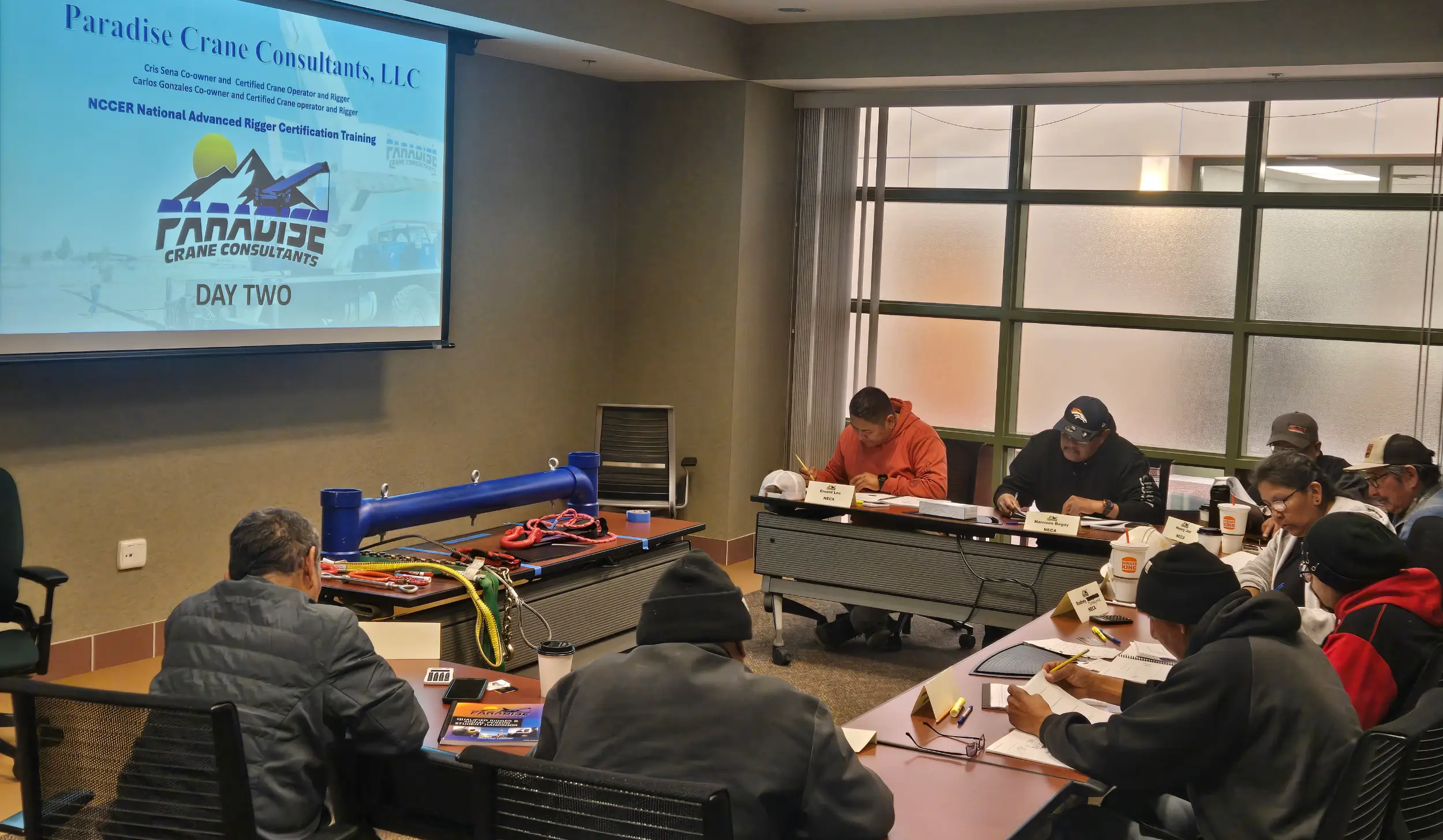
Individual operators can prepare for NCCER certification in open-enrollment classes in Albuquerque. For crews, Paradise Crane travels to your Nebraska facility or job site and builds training around the equipment you actually run, including power-line clearance under both the state statute and the federal standard.
The common mistake in Nebraska is assuming that a federal-OSHA state has no crane rules of its own. Nebraska's High Voltage Law, Neb. Rev. Stat. 48-436 to 48-442, is a separate state statute with criminal penalties. It prohibits operating a crane or other boom equipment anywhere a part of it could come within 10 feet of an overhead conductor carrying more than 600 volts, unless the line has been guarded by barriers, de-energized and grounded, or temporarily relocated. Those measures must be performed by the line's owner or operator unless you hold written authorization. Cranes in transit with no load and the boom lowered may close to 4 feet. Each violation is a Class V misdemeanor, and each day of noncompliance counts separately.
The trap is treating the state's 10 feet as federal compliance. Under 29 CFR 1926.1408, you must first determine whether the equipment could come within 20 feet of a power line, then de-energize, hold 20 feet, or apply Table A. Table A permits 10 feet only for lines up to 50 kV; it requires 15 feet up to 200 kV and 20 feet up to 350 kV. A crew working to the Nebraska number near a transmission line can be in violation of the federal rule. Work to whichever distance is greater: meeting Table A satisfies the state statute, but meeting the state's 10 feet does not satisfy OSHA.
Everything else runs through federal OSHA. Nebraska has no OSHA-approved State Plan and issues no crane operator license; the Omaha Area Office enforces 29 CFR 1926 Subpart CC for private-sector employers statewide. Federal OSHA does not cover state and local government employers, and with no State Plan to fill the gap, public-sector crews, including those at the state's public power districts, fall outside OSHA entirely. The High Voltage Law still reaches them.

NCCER certification is the right foundation for operating in Nebraska, and because the state issues no crane operator license, there is no second state credential to stack on top of it.
The federal standard still asks for more than a certificate. The employer must train each operator, ensure certification for the type of equipment being operated, and evaluate the operator on the specific equipment before assigning work, with the evaluation documented. Certification from an accredited testing organization is valid for no more than five years, and under 29 CFR 1926.1427(c)(3) the employer must provide it at no cost to the employee.
What Nebraska adds is operational, not credential-based. Operators and signal persons need to know the state's 10-foot rule and its limits: it is a floor for lines up to 50 kV, not a substitute for the federal 20-foot assessment and Table A distances. Public employers covered by the Nebraska Workers' Compensation Act, which sit outside federal OSHA, must also maintain a safety committee and written injury prevention program under amended Neb. Rev. Stat. 48-443.
Nebraska recorded 25 fatal work injuries in 2024, down 45.7 percent from 46 the year before, according to the U.S. Bureau of Labor Statistics Census of Fatal Occupational Injuries. The state's fatal injury rate fell to 2.6 per 100,000 full-time-equivalent workers, from 4.8 in 2023, against a national count of 5,070 fatalities that fell 4.0 percent.
Transportation incidents caused 17 of the 25 deaths, or 68 percent, compared with 38 percent nationally. Construction accounted for 4 fatalities in both 2023 and 2024. Small state totals swing sharply from year to year: Nebraska recorded 57 work fatalities in 2022.
These are statewide figures covering all industries, not crane-specific data. They describe the conditions your crews are working in, and they are the numbers an inspector has in mind when arriving on your site.
Paradise Crane delivers certification preparation and safety training tailored to your equipment type, crew size, and project needs.
Prepare your crew for nationally recognized certification exams with classroom and hands-on instruction.
Develop rigging skills and communication protocols essential for safe lift operations on your jobsite.
Train supervisors and coordinators to manage complex lift operations and equipment setup safely.
Meet OSHA requirements with qualified person training in fall protection systems and hazard recognition.
Ensure your team understands hazards and entry procedures for confined spaces and excavation work.
Train crane inspectors to identify defects and verify safe operating conditions for overhead crane equipment and related systems.
Paradise Crane has trained crane and heavy equipment operators since 1996, including work with the U.S. Department of Energy, Sandia National Laboratories, and Los Alamos National Laboratory.
Select a city below to learn more about on-site crane training and certification availability in your area.
Before your next covered lift in Nebraska, work through these in order:
Common questions about crane training and certification in Washington.
Yes. Paradise Crane delivers on-site training across Washington State. We coordinate scheduling and logistics to fit your crew's location and availability.
That's our standard approach. We bring classroom and hands-on instruction to your jobsite, yard, or facility to minimize downtime and travel.
Washington enforces its own crane rules through L&I (WAC 296-155 Part L), which exceed federal OSHA. Operators must hold a valid certificate from a nationally accredited testing organization for each crane type, and cranes must be certified and proof-load tested annually by an L&I-recognized certifier. Updated rules took effect September 5, 2025.
Paradise Crane recommends scheduling four to six weeks in advance. This allows time to coordinate travel, prepare materials, and align with your crew’s availability. Paradise Crane can in some cases accommodate classes booked as late as 7 days in advance, as long as our teaching schedule allows.
We provide certification preparation for NCCER and support training for crane operators, riggers, signalpersons, and lift directors. Paradise Crane also offers OSHA qualification classes and specialized safety training, including fall protection and confined space training.
Request on-site crane certification preparation and operator training tailored to your crew, equipment, and location anywhere in Nebraska.