Idaho looks like a light-touch state for crane work: no State Plan, no crane standard, no operator license. The one state law on the books is the trap. Idaho's overhead line statute sets its own clearance formula, and that formula is more permissive than federal Table A at most transmission voltages, so a crew that follows Idaho's math to the inch can still be cited. The same statute lets the utility refuse the clearance you ask for.
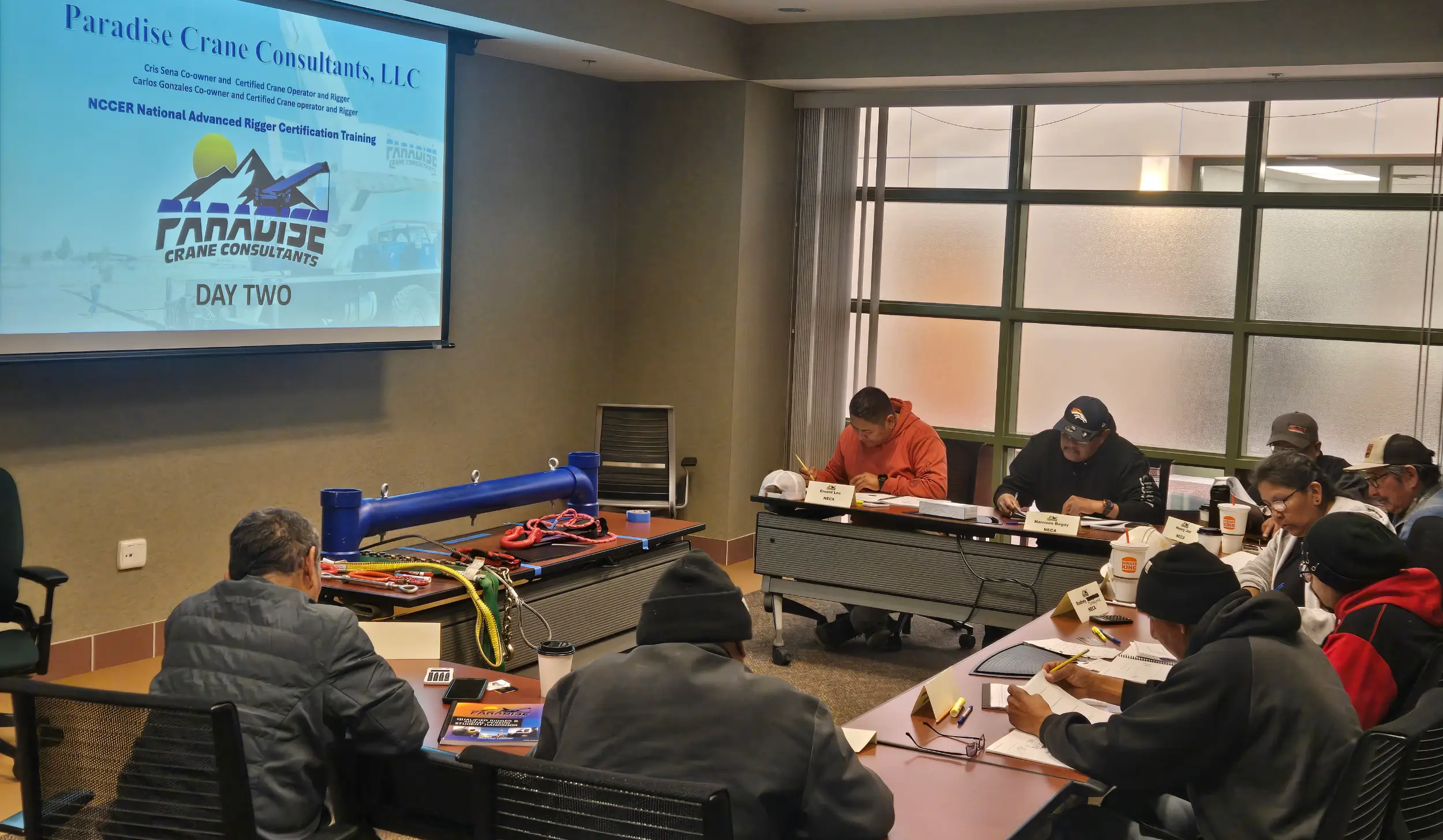
Individual operators can prepare for NCCER certification in open-enrollment classes in Albuquerque. For crews, Paradise Crane travels to your Idaho facility or job site and trains on the equipment you actually run, including the power-line planning both rulebooks demand.
Idaho wrote no crane standard of its own — federal OSHA enforces 29 CFR 1926 Subpart CC here directly, out of the Boise Area Office, and there is no OSHA-approved State Plan. What Idaho did write is a clearance formula, and the formula is the problem. Idaho Code 55-2402 requires ten feet from any high-voltage overhead line, meaning anything above 600 volts, rated 50 kV or less, and above 50 kV it adds four-tenths of an inch per kilovolt. A crew that works out 12 feet 11 inches for a 138 kV line has done real arithmetic and may reasonably believe it is covered. It is not. Federal Table A in 29 CFR 1926.1408 requires fifteen feet for any line above 50 kV up to 200 kV.
The shortfall is structural rather than accidental. Table A is a staircase: ten feet to 50 kV, fifteen to 200, twenty to 350, twenty-five to 500. Idaho's formula is a straight line drawn between those steps, so it meets the federal distance only at 50, 200, 350 and 500 kV and permits a shorter one at every voltage in between. The gap is widest just above each step. At 69 kV, a common transmission voltage, Idaho's formula allows ten feet eight inches where OSHA requires fifteen — a shortfall of more than four feet.
The second Idaho-specific fact is that the clearance you need may not be available at all. To work inside the statutory distance you must notify the utility in writing, and both parties must sign an agreement identifying the arrangements and the payment. The utility may charge its actual costs, may require payment in advance, and may refuse outright if it judges the work would jeopardize the performance, integrity, reliability or stability of its system or any system interconnected with it. No deadline binds it and nothing obliges it to say yes. The civil penalty for violating the statute is up to $500, which is trivial next to what sits behind it: if a violation causes contact with the line, the contractor is liable to the utility for all damage to its facilities and all costs and expenses it incurs, including damages the utility owes to third parties.

NCCER certification is the foundation for crane work in Idaho, and because the state issues no crane operator license, there is no second state credential to earn. No crane or hoisting credential appears among the professions regulated by the Idaho Division of Occupational and Professional Licenses.
What applies is the federal rule. Under 29 CFR 1926.1427, an operator must be certified for the type of equipment being operated by an accredited crane operator testing organization, that certification is valid for no more than five years, and subsection (c)(3) requires the employer to provide it at no cost to the employee. The employer must then evaluate each operator on the specific equipment and configuration they will run and document it — the operator's name, the evaluator's name and signature, the date, and the make, model and configuration — and keep that record available at the worksite. A certificate alone does not make an operator qualified.
What Idaho adds is a training obligation that is practical rather than credential-based. Operators and signal persons here have to carry two sets of clearance numbers: the state formula, which governs when the utility must be notified and when liability attaches, and federal Table A, which governs the distance you actually hold. Confusing the two is how a crew ends up compliant with the statute and cited by OSHA on the same lift.
Idaho recorded 45 fatal work injuries in 2024, down from 48 the year before, according to the Census of Fatal Occupational Injuries published by the Idaho Department of Labor with the U.S. Bureau of Labor Statistics.
Construction accounted for 18 of them, a private-industry count measured against a statewide total that covers all ownerships, against 6 the year before. In a single year construction went from roughly an eighth of Idaho's workplace deaths to 40 percent of a smaller total.
A single year does not make a trend, and counts this small move sharply on a handful of incidents. It is still a shift worth knowing about before planning work here, and it is the steepest one-year change in any state we train in.
These are statewide figures covering all industries, not crane-specific data.
Paradise Crane delivers certification preparation and safety training tailored to your equipment type, crew size, and project needs.
Prepare your crew for nationally recognized certification exams with classroom and hands-on instruction.
Develop rigging skills and communication protocols essential for safe lift operations on your jobsite.
Train supervisors and coordinators to manage complex lift operations and equipment setup safely.
Meet OSHA requirements with qualified person training in fall protection systems and hazard recognition.
Ensure your team understands hazards and entry procedures for confined spaces and excavation work.
Train crane inspectors to identify defects and verify safe operating conditions for overhead crane equipment and related systems.
Paradise Crane has trained crane and heavy equipment operators since 1996, including work with the U.S. Department of Energy, Sandia National Laboratories, and Los Alamos National Laboratory.
Select a city below to learn more about on-site crane training and certification availability in your area.
Before your next covered lift in Idaho, work through these in order:
Common questions about crane training and certification in Washington.
Yes. Paradise Crane delivers on-site training across Washington State. We coordinate scheduling and logistics to fit your crew's location and availability.
That's our standard approach. We bring classroom and hands-on instruction to your jobsite, yard, or facility to minimize downtime and travel.
Washington enforces its own crane rules through L&I (WAC 296-155 Part L), which exceed federal OSHA. Operators must hold a valid certificate from a nationally accredited testing organization for each crane type, and cranes must be certified and proof-load tested annually by an L&I-recognized certifier. Updated rules took effect September 5, 2025.
Paradise Crane recommends scheduling four to six weeks in advance. This allows time to coordinate travel, prepare materials, and align with your crew’s availability. Paradise Crane can in some cases accommodate classes booked as late as 7 days in advance, as long as our teaching schedule allows.
We provide certification preparation for NCCER and support training for crane operators, riggers, signalpersons, and lift directors. Paradise Crane also offers OSHA qualification classes and specialized safety training, including fall protection and confined space training.
Request on-site crane certification preparation and operator training tailored to your crew, equipment, and location anywhere in Idaho.