If you run cranes in Arizona, the federal crane standard is the rule. What changes is how it is enforced: ADOSH has made heat an inspection priority, and summer cab and ground temperatures turn routine lifts into heat exposures.
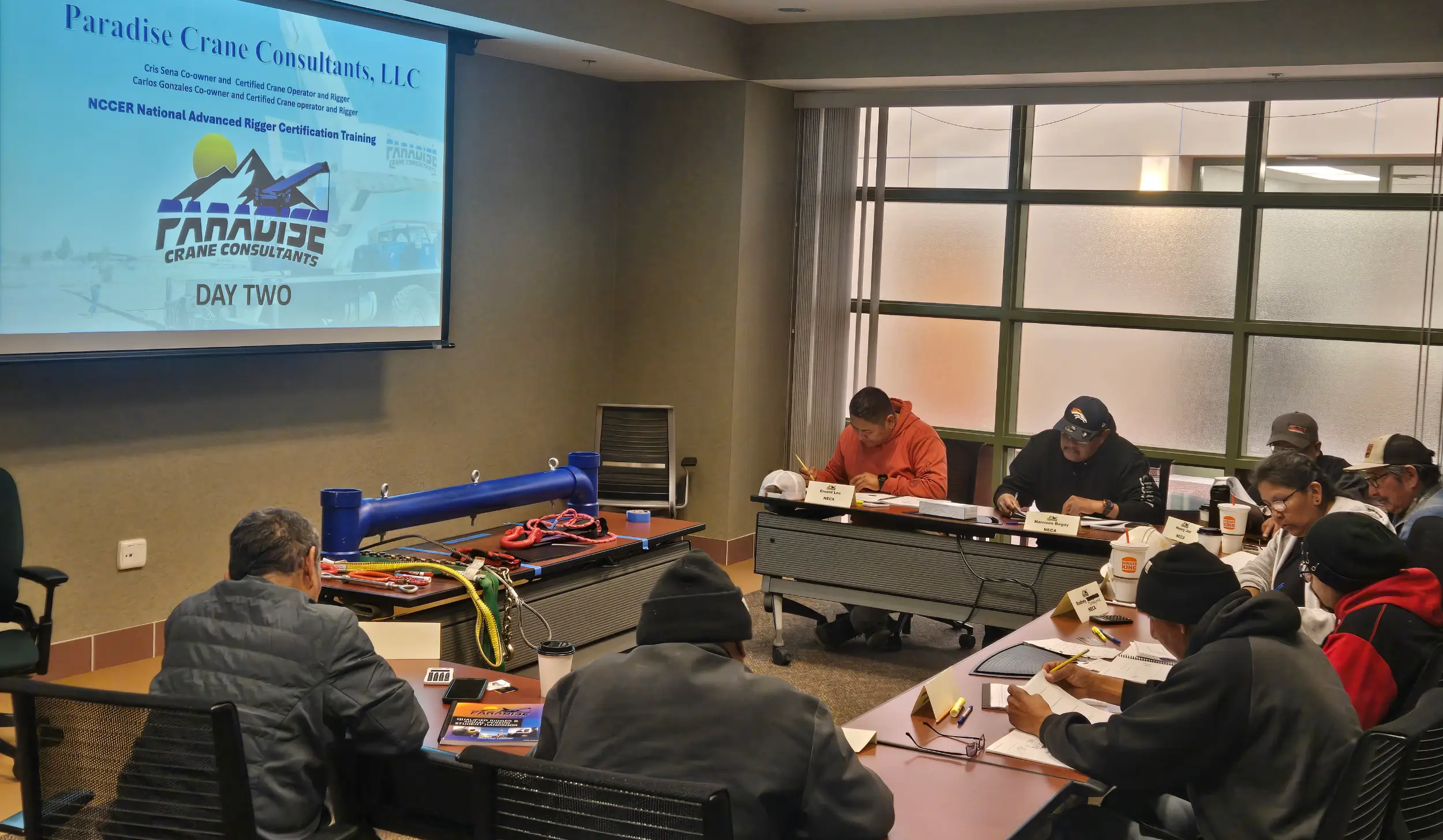
Individual operators can prepare for NCCER certification in open-enrollment classes in Albuquerque. For crews, Paradise Crane travels to your Arizona facility or job site and trains on the equipment you actually run, from fab-site tool setting in Phoenix to mill and plant work in Kingman and Casa Grande.
No. Arizona runs its own occupational safety program, but on cranes it follows the federal rule. Workplace safety here is enforced by the Arizona Division of Occupational Safety and Health (ADOSH), part of the Industrial Commission of Arizona, under a State Plan first approved on November 5, 1974 and given final approval on June 20, 1985. The plan covers private employers along with state and local government. Arizona adopts all of 29 CFR 1926, including the cranes and derricks standard in Subpart CC, by reference at A.A.C. R20-5-601, with no crane-specific changes of its own.
That has not always been a given. In 2012 Arizona passed a law setting a 15-foot fall protection trigger for residential construction. Federal OSHA found it less protective than the federal standard, and it was repealed in February 2015. ADOSH has enforced the federal fall protection rules since. In 2022 federal OSHA proposed revoking the plan's final approval; it withdrew that proposal on February 15, 2023, after Arizona adopted the standards it had been missing.
Where Arizona does stand apart is heat. ADOSH has run a Heat State Emphasis Program since July 17, 2023, which makes heat hazards an inspection priority, and it cites them under the General Duty Clause. On December 31, 2025, a state task force delivered Heat Guidelines for Employers covering water, shade, rest, acclimatization and written heat plans. Those guidelines are guidance, not a rule. Separately, Phoenix requires contractors on City contracts to keep a written heat safety plan and working air conditioning in enclosed-cab vehicles. For a crane crew, that puts the cab, the ground crew and the summer schedule inside the heat plan.

NCCER certification is the right foundation for operating in Arizona. ADOSH adopts the federal operator qualification and certification rule, and we found no separate state crane operator license. Employers rely on certification from a nationally accredited testing organization such as NCCER, or on an audited employer program.
Accredited certification is portable and valid for five years, and under 29 CFR 1926.1427 the employer must provide it at no cost to the employee. Certification does not finish the job. Before an operator runs a crane unsupervised, the employer must evaluate them on the assigned equipment and document it: the operator's name, the evaluator's name and signature, the date, and the make, model and configuration. That record must be available at the worksite.
Riggers and signal persons need their own qualification under Subpart CC. On Arizona job sites, the people around the crane face the same summer heat as the operator, so their training should cover heat illness alongside rigging and signals.
Arizona recorded 94 fatal work injuries in 2024, down from 103 the year before, according to the U.S. Bureau of Labor Statistics Census of Fatal Occupational Injuries. The state's fatal injury rate was 2.8 per 100,000 full-time-equivalent workers, down from 3.1 in 2023.
The construction industry accounted for 24 of those deaths, about 26 percent of the state total. Falls to a lower level caused 13 deaths across all industries.
One category stands out in a desert state: exposure to harmful substances or environments caused 19 deaths, about 20 percent of the total. BLS does not break out heat on its own, but that is the category heat illness falls into.
These are statewide figures covering all industries, not crane-specific data.
Paradise Crane delivers certification preparation and safety training tailored to your equipment type, crew size, and project needs.
Prepare your crew for nationally recognized certification exams with classroom and hands-on instruction.
Develop rigging skills and communication protocols essential for safe lift operations on your jobsite.
Train supervisors and coordinators to manage complex lift operations and equipment setup safely.
Meet OSHA requirements with qualified person training in fall protection systems and hazard recognition.
Ensure your team understands hazards and entry procedures for confined spaces and excavation work.
Train crane inspectors to identify defects and verify safe operating conditions for overhead crane equipment and related systems.
Paradise Crane has trained crane and heavy equipment operators since 1996, including work with the U.S. Department of Energy, Sandia National Laboratories, and Los Alamos National Laboratory.
Select a city below to learn more about on-site crane training and certification availability in your area.
Before your next covered lift in Arizona, work through these in order:
Common questions about crane training and certification in Washington.
Yes. Paradise Crane delivers on-site training across Washington State. We coordinate scheduling and logistics to fit your crew's location and availability.
That's our standard approach. We bring classroom and hands-on instruction to your jobsite, yard, or facility to minimize downtime and travel.
Washington enforces its own crane rules through L&I (WAC 296-155 Part L), which exceed federal OSHA. Operators must hold a valid certificate from a nationally accredited testing organization for each crane type, and cranes must be certified and proof-load tested annually by an L&I-recognized certifier. Updated rules took effect September 5, 2025.
Paradise Crane recommends scheduling four to six weeks in advance. This allows time to coordinate travel, prepare materials, and align with your crew’s availability. Paradise Crane can in some cases accommodate classes booked as late as 7 days in advance, as long as our teaching schedule allows.
We provide certification preparation for NCCER and support training for crane operators, riggers, signalpersons, and lift directors. Paradise Crane also offers OSHA qualification classes and specialized safety training, including fall protection and confined space training.
Request on-site crane certification preparation and operator training tailored to your crew, equipment, and location anywhere in Arizona.