If you employ crane operators in Washington, the federal standard is your floor rather than your ceiling. Washington runs its own OSHA-approved State Plan, and it wrote its own crane rules rather than adopting the federal ones — which means there are obligations here that a nationally certified operator and a properly certified crane will not automatically satisfy on arrival.
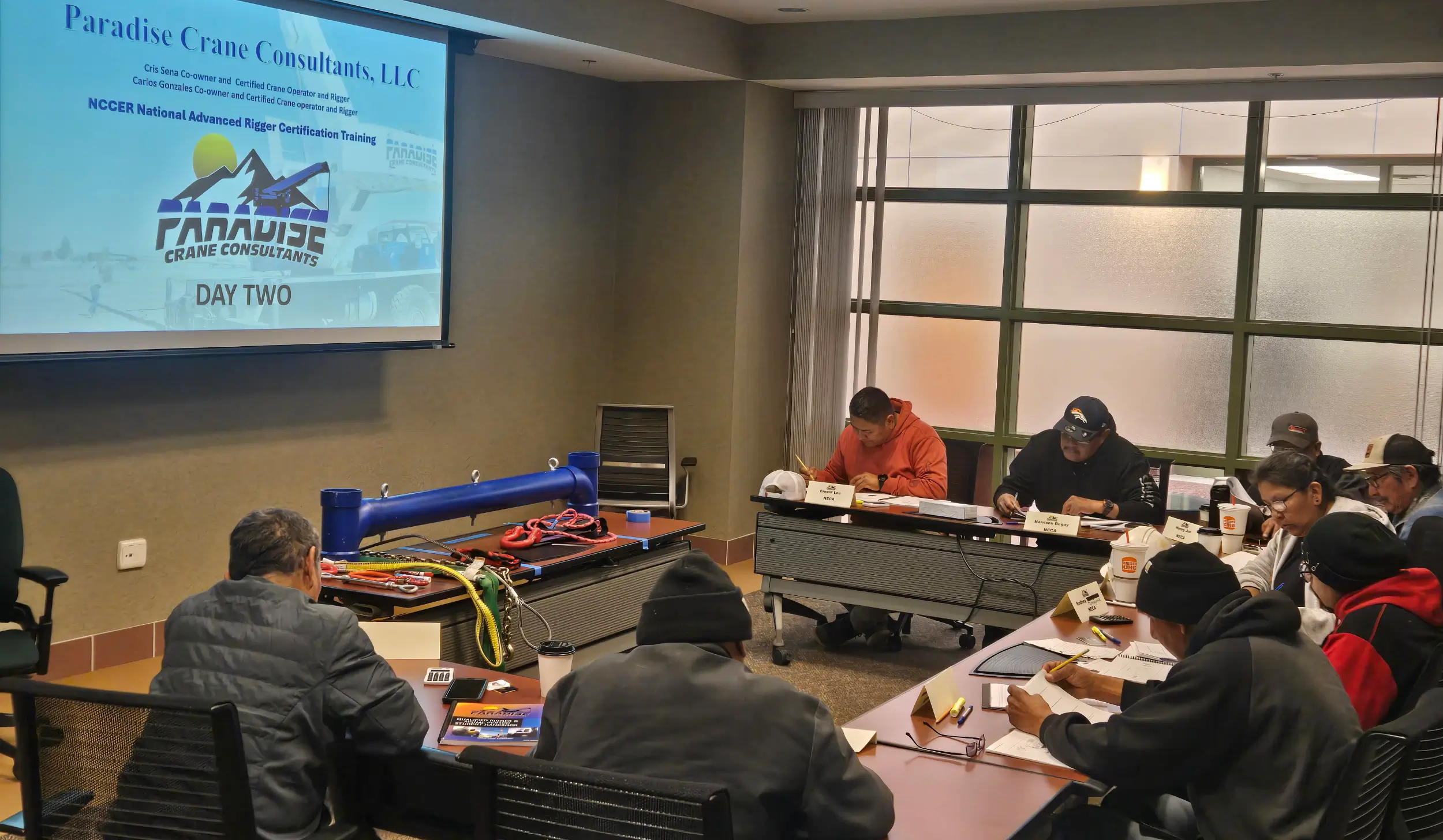
That matters most when an audit is coming, when you are onboarding operators, when equipment changes hands, or when a near-miss has put your documentation under scrutiny. Paradise Crane brings on-site training to your facility or job site, built around the equipment your crews actually run.
Workplace safety enforcement in Washington runs through the state Department of Labor & Industries, Division of Occupational Safety and Health, known as DOSH. Washington has operated an OSHA-approved State Plan since 1973, covering private-sector employers alongside state and local government. Federal OSHA retains enforcement in a narrow set of settings — maritime employment, military reservations and national parks, tribal establishments, certain Hanford Reservation contract work, and USPS contract operations.
What matters most for crane work is that Washington did not adopt the federal crane standard by reference. Chapter 296-155 WAC, Part L is a distinct Washington construction standard, and it carries obligations that go beyond 29 CFR 1926 Subpart CC.
The clearest example applies to your equipment rather than your people. Every crane covered by Part L must be certified annually by an accredited certifier recognised by the department, and the crane owner must ensure a current annual certificate of operation is in place before the crane performs construction work. Tower cranes require this again after each reconfiguration. There is no federal counterpart to this requirement, and a crane brought into Washington from another state does not arrive with it satisfied.
NCCER certification is the right foundation for operating in Washington, but it is one of several things the state expects you to be able to produce.
Washington requires a valid operator certificate for the specific type of crane being operated, issued by a testing organisation accredited by a nationally recognised accrediting agency. Those certificates are valid for a maximum of five years. Beyond that, Part L adds three requirements with no federal equivalent: operators must document minimum hours of experience by crane type and capacity, they must pass a substance abuse test at a recognised laboratory, and the employer must provide certification and recertification at no cost to the employee.
The experience thresholds are specific. A crane of 5 tons or under calls for 8 hours of operating experience; a lattice boom crane of 300 tons or above calls for 1,000 hours of operating experience plus 1,000 hours of crane-related experience. Your records need to separate those two categories by crane type and capacity.
Washington recorded 102 fatal work injuries in 2024, up 5.2 percent from 97 the year before, according to the U.S. Bureau of Labor Statistics Census of Fatal Occupational Injuries. The state's fatal injury rate was 2.8 per 100,000 full-time-equivalent workers, against a national count of 5,070 fatalities that fell 4.0 percent over the same period.
Construction accounted for 16 of those 102 deaths. Falls, slips or trips caused 8 of the 16, and specialty trade contractors accounted for 9 — meaning the majority of construction fatalities in the state occurred among subcontracted trades rather than general contractors.
These are statewide figures covering all industries, not crane-specific data. They describe the conditions your crews are working in, and they are the numbers an inspector has in mind when arriving on your site.
Paradise Crane delivers certification preparation and safety training tailored to your equipment type, crew size, and project needs.
Prepare your crew for nationally recognized certification exams with classroom and hands-on instruction.
Develop rigging skills and communication protocols essential for safe lift operations on your jobsite.
Train supervisors and coordinators to manage complex lift operations and equipment setup safely.
Meet OSHA requirements with qualified person training in fall protection systems and hazard recognition.
Ensure your team understands hazards and entry procedures for confined spaces and excavation work.
Train crane inspectors to identify defects and verify safe operating conditions for overhead crane equipment and related systems.
Paradise Crane has trained crane and heavy equipment operators since 1996, including work with the U.S. Department of Energy, Sandia National Laboratories, and Los Alamos National Laboratory.
Select a city below to learn more about on-site crane training and certification availability in your area.
On-site operator certification and rigger training for Seattle-area construction and industrial operations.
Certification preparation and safety training delivered at your Spokane facility or jobsite.
Operator and rigger training for Colville construction, and industrial sectors.
On-site certification and safety training across the Pasco-area construction and infrastructure projects.
Operator certification and rigging training for Walla Walla-area industrial, and construction operations.
Certification preparation and hands-on training delivered on-site across Tacoma-area.
Certification preparation and hands-on training delivered on-site across Bellingham-area
Certification preparation and hands-on training delivered on-site across Olympia-area.
Certification preparation and hands-on training delivered on-site across Leavenworth-area.
Certification preparation and hands-on training delivered on-site across Pullman-area.
Before your next covered lift in Washington, work through these in order:
Common questions about crane training and certification in Washington.
Yes. Paradise Crane delivers on-site training across Washington State. We coordinate scheduling and logistics to fit your crew's location and availability.
That's our standard approach. We bring classroom and hands-on instruction to your jobsite, yard, or facility to minimize downtime and travel.
Washington enforces its own crane rules through L&I (WAC 296-155 Part L), which exceed federal OSHA. Operators must hold a valid certificate from a nationally accredited testing organization for each crane type, and cranes must be certified and proof-load tested annually by an L&I-recognized certifier. Updated rules took effect September 5, 2025.
Paradise Crane recommends scheduling four to six weeks in advance. This allows time to coordinate travel, prepare materials, and align with your crew’s availability. Paradise Crane can in some cases accommodate classes booked as late as 7 days in advance, as long as our teaching schedule allows.
We provide certification preparation for NCCER and support training for crane operators, riggers, signalpersons, and lift directors. Paradise Crane also offers OSHA qualification classes and specialized safety training, including fall protection and confined space training.
Request on-site crane certification preparation and operator training tailored to your crew, equipment, and location anywhere in Washington.