If you've tried to figure out what certifications are actually required for construction equipment, you've probably run into the same problem most companies do: conflicting answers that usually lead to spending more than necessary.
After working with contractors, safety managers, and crews across different industries, I can tell you that most companies either over-certify or under-qualify — and both mistakes cost money. Here's what's actually required, what isn't, and how to get it right the first time.
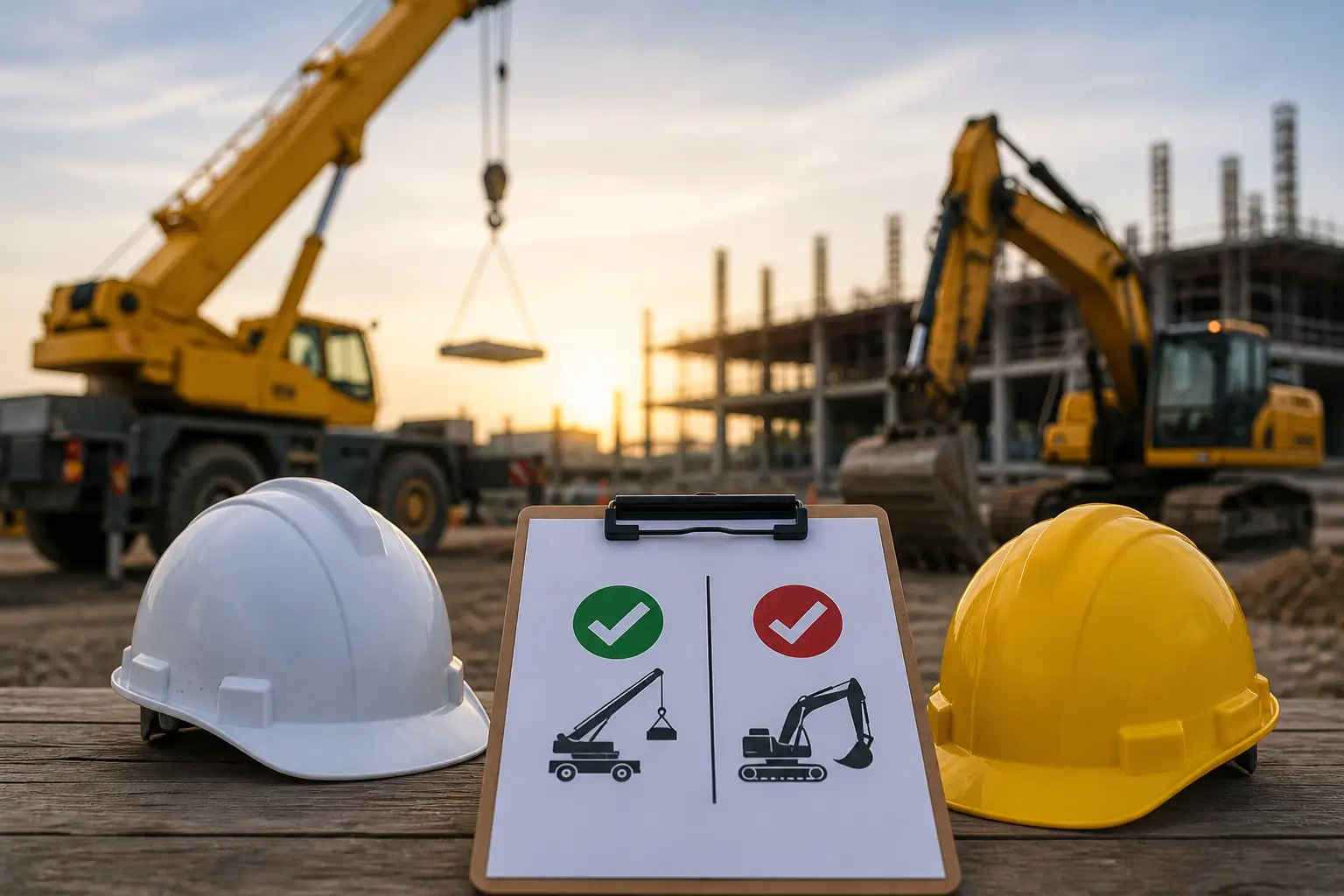
Before we talk about specific equipment, this distinction has to be clear. OSHA requires equipment operators to be qualified — meaning they've completed training (classroom and hands-on), passed a written exam, and demonstrated practical competency. Certification means holding a credential from an ANAB-accredited organization like NCCCO or NCCER. That's a higher standard, and it's only required for cranes working in construction.
The most expensive assumption I see companies make is treating these as interchangeable. They're not.
Telehandlers, dedicated pile drivers, and digger derricks come up constantly. Companies routinely pay for certifications on this equipment when OSHA qualification is all that's required.
an Digger derricks are a good example. Depending on the work being performed, they're often exempt from certification requirements entirely — meaning operators need to be qualified, not certified. That's a significant difference in cost and time, and most companies don't find out until after they've already paid.
Under OSHA Subpart CC, which governs cranes in construction, certification applies when equipment is power-operated, used in construction, and capable of hoisting, lowering, or horizontally moving a suspended load. That last piece — the suspended load — is the determining factor.
Equipment that typically falls under this requirement includes mobile cranes, crawler cranes, articulating cranes, floating cranes and cranes on barges, locomotive cranes, and multi-purpose machines configured with a winch. If it's lifting and moving a suspended load on a construction site, certification is likely required.
Even on active construction sites, a number of equipment types are excluded from certification requirements. Excavators, wheel loaders, backhoes, loader backhoes, track loaders, dedicated drilling rigs, mechanics trucks used for maintenance or repair, and tree trimming equipment all fall outside the certification mandate. Digger derricks get their own carve-out when used specifically for augering holes, setting poles, or working with telecom or electrical lines — which covers a large portion of how they're actually used in the field.
The first is getting certified when qualification was all that was needed. You pay more, spend more time in training, and add complexity that wasn't necessary.
The second is getting qualified when certification was actually required. Operators show up to a job site and get turned away. Training has to be redone. Projects get delayed. In both scenarios, companies end up paying twice — either in money, time, or both.
The line between general industry and construction work isn't always obvious, and it matters. Dropping materials at a job site randomly might fall under general industry rules. Organizing those same materials as part of a construction workflow could shift the classification entirely — and with it, whether certification applies. When the scope of work sits near that line, it's worth getting clarity before scheduling training.
The fastest path to a clear answer is talking to a reputable training provider before you commit to anything. They can tell you whether you need qualification, certification, or both based on your specific equipment and work context. If the situation is genuinely ambiguous, your local OSHA office can provide guidance, and in some cases you can request a formal Letter of Interpretation.
Also worth checking: general contractors and individual job sites sometimes impose requirements beyond OSHA minimums. Showing up qualified when the GC requires certification is a problem that's easy to avoid with one phone call in advance.
Most of the time, the answer is simpler — and cheaper — than companies expect. Qualification covers the majority of construction equipment. Certification is a narrower requirement than most people realize. And the difference between getting it right and getting it wrong is usually just asking the right question before training gets scheduled.