If you've ever asked this question, you're probably asking it for the right reason: Am I doing this correctly — and am I about to overspend?
I've had this conversation hundreds of times with contractors, safety managers, and business owners who were told they needed certification when, in reality, they didn't. That misunderstanding can cost thousands of dollars, delay jobs, and create compliance headaches that were entirely avoidable.
Here's what you actually need to know.
These two words get used interchangeably, but they mean very different things from a compliance standpoint.
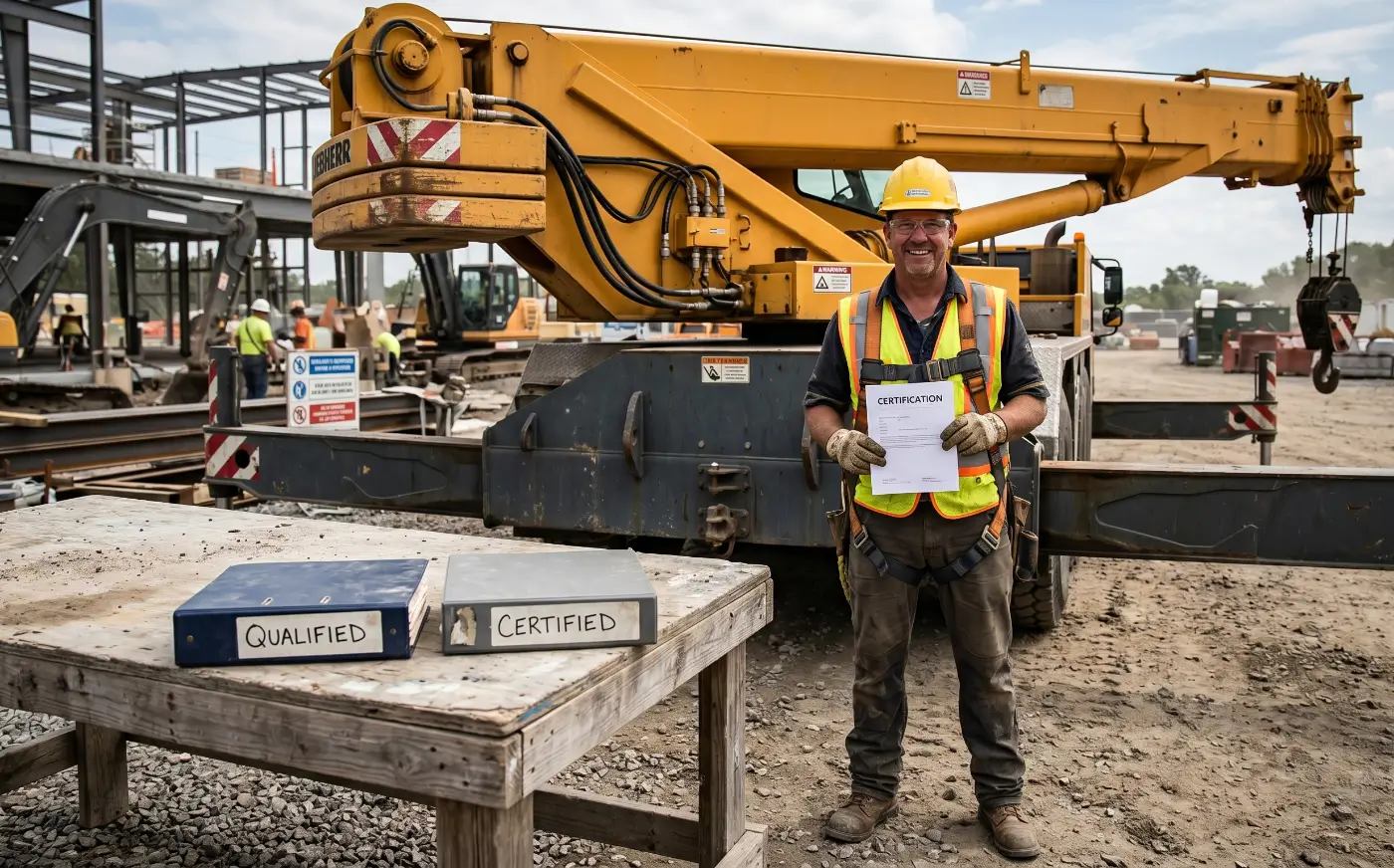
A qualified operator is someone who has received proper training, passed a written exam, passed a hands-on practical evaluation, and been assessed as competent for the task. This is an OSHA requirement.
A certified operator holds a credential issued by an ANSI/ANAB-accredited organization — like NCCCO or NCCER — through a standardized testing process. This is a higher bar, and it costs significantly more time and money to achieve. The distinction that matters most: OSHA requires qualification, not certification, in most cases.
Companies routinely overspend because they assume certification is always required. It isn't.
ANAB-accredited certification is only mandated in one specific scenario: operating cranes in construction. That's it.
Everything else— rigging, signalperson work, forklifts, and most crane operations in general industry —only requires qualification. Yet I regularly talk to companies that have already paid for full NCCCO or NCCER certifications for riggers and signal persons before anyone told them OSHA doesn't require it.
The cost difference is significant. Qualification can typically be completed in a single day and at a fraction of the price. Certification usually takes three to five days and requires accredited testing bodies that are difficult to replicate in-house. If you don't need certification, choosing it anyway is one of the fastest ways to burn through a training budget.
A lot of the confusion comes down to industry classification. Operators working in manufacturing, oil fields, or facilities with overhead cranes are often in general industry — not construction — and the rules are different.
I worked with companies doing wireline work in oilfields where crane use involved lifting a lubricator and leaving it in place for extended periods. Requiring full certification in that context added unnecessary cost and operational strain. With the right OSHA interpretation, those operators could work under qualification only.
That said, the line between general industry and construction isn't always obvious. Dropping materials randomly on a job sitemight fall under general industry. Organizing those same materials as part of a construction workflow could shift you into construction territory — where certification requirements may apply. A digger derrick doing material handling is a very different situation from one doing installation work. These gray areas are where companies get tripped up.
If the certification-vs.-qualification confusion is the most common mistake, this one is the most painful.
I've seen companies pay $70–$80 for online-only training programs, send operators to a job site, and get turned away immediately. The reason: OSHA requires demonstrated competency and a practical evaluation. An online exam alone doesn't satisfy that requirement.
The fallout is usually a scramble to schedule last-minute certification classes, double-paying for training, and project delays that can stretch a week or more. It's an entirely avoidable situation that happens more often than it should.
Certification does look better on paper, but it doesn't automatically translate to better insurance outcomes. What does create liability exposure is in-house qualification done improperly. If something goes wrong and your internal process can't hold up to scrutiny, you're in a worse position than if you'd used a third-party provider.
That's why many companies choose third-party qualification even when certification isn't required — not because the rules demand it, but because it protects them if something ever goes sideways.
Honestly, it's not always obvious — even for experienced companies. General contractors sometimes require certification without explaining why. Individual job sites may have their own standards. Insurance policies can influence decisions. And in genuinely ambiguous situations, the only definitive answer may come from an OSHA letter of interpretation.
My advice after years of doing this: don't guess, and don't default to certification "just to be safe." Talk to a reputable training provider before you schedule anything. Most of the time, you don't need certification — you just need to be properly qualified. And when you do need certification, a good provider will tell you that too. The right answer isn't always the most expensive one. It's the one that keeps you compliant and keeps your projects moving.